Tuesday, 26 February 2013

Red carpet


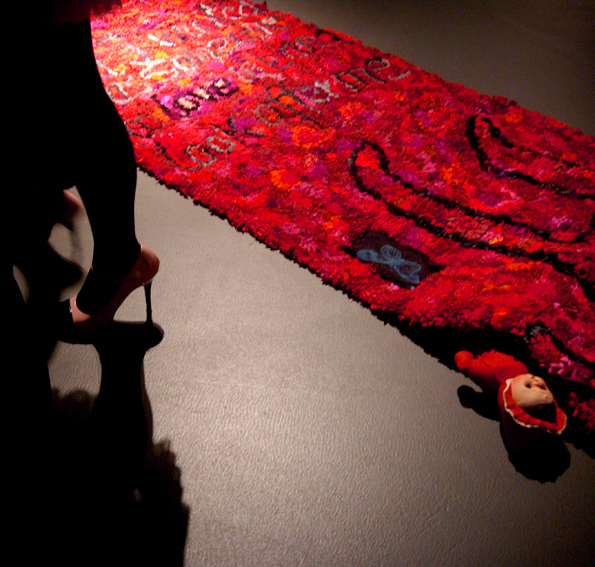
'Red may have been purple in antiquity as the Greeks had a very different conception of colour  to ours. For instance they had no word for true blue. Was Clytemnestra's carpet purple, or was it crimson? Was the imperial purple, in fact, red? Let us believe that Clytemnestra wove a crimson carpet for Agamemnon - blood red with a touch of blue in the blood. When he stepped on this first red carpet, he committed the sin of hubris - and was murdered. Red carpets lead to assessination. Revolutions die in their own red. Have you ever stepped on a red carpet? Felt the pomp and circumstance? Before it was pulled from under your feet? Red betrays.'

Derek Jarman (2000), Chroma: a book of colour - June '93. London: Vintage, p. 38

Thursday, 21 February 2013

between going and staying


Entre irse y quedarse duda el día,
enamorado de su transparencia.

La tarde circular es ya bahía:
en su quieto vaivén se mece el mundo.

Todo es visible y todo es elusivo,
todo está cerca y todo es intocable.

Los papeles, el libro, el vaso, el lápiz
reposan a la sombra de sus nombres.

Latir del tiempo que en mi sien repite
la misma terca sílaba de sangre.

La luz hace del muro indiferente
un espectral teatro de reflejos.

En el centro de un ojo me descubro;
no me mira, me miro en su mirada.

Se disipa el instante. Sin moverme,
yo me quedo y me voy: soy una pausa.

Octavio Paz

Between Going and Staying

Between going and staying
the day wavers,
in love with its own transparency.
The circular afternoon is now a bay
where the world in stillness rocks.

All is visible and all elusive,
all is near and can’t be touched.

Paper, book, pencil, glass,
rest in the shade of their names.

Time throbbing in my temples repeats
the same unchanging syllable of blood.

The light turns the indifferent wall
into a ghostly theater of reflections.

I find myself in the middle of an eye,
watching myself in its blank stare.

The moment scatters. Motionless,
I stay and go: I am a pause.

Friday, 15 February 2013

'secret joy in a mist of gold'

(So was it with Helen in Troy.)

  And how shall I call the thing that came
    At the first hour to Ilion city?
  Call it a dream of peace untold,
  A secret joy in a mist of gold,
  A woman's eye that was soft, like flame,
    A flower which ate a man's heart with pity.
 
'Agamemnon' by Aeschylus


Wednesday, 13 February 2013

precarious equilibrium of being


'Listen: Good things, things that do no harm are not the things to watch. They don't require the alert arts. Disaster, folly, the precarious equilibrium of being, the inertial contradictions of phenomena, these, collectively,  are a delicate situation to be understood and in part manipulated. Many have no capacity of such nuance. I say this to you only because I know that you and I are in perfect accord.'

Russell Atkins (1971), Maleficium. Ohio: Freelance Press, p.1

Eclipse Archive

Tuesday, 12 February 2013

Delight


Delight is as the flight—
Or in the Ratio of it,
As the Schools would say—
The Rainbow's way—
A Skein
Flung colored, after Rain,
Would suit as bright,
Except that flight
Were Aliment—

"If it would last"
I asked the East,
When that Bent Stripe
Struck up my childish
Firmament—
And I, for glee,
Took Rainbows, as the common way,
And empty Skies
The Eccentricity—

And so with Lives—
And so with Butterflies—
Seen magic—through the fright
That they will cheat the sight—
And Dower latitudes far on—
Some sudden morn—
Our portion—in the fashion—
Done—

Saturday, 9 February 2013

'come travel in dreams'

La Voix
Mon berceau s'adossait à la bibliothèque,
Babel sombre, où roman, science, fabliau,
Tout, la cendre latine et la poussière grecque,
Se mêlaient. J'était haut comme un in-folio.
Deux voix me parlaient. L'une, insidieuse et ferme,
Disait: «La Terre est un gâteau plein de douceur;
Je puis (et ton plaisir serait alors sans terme!)
Te faire un appétit d'une égale grosseur.»
Et l'autre: «Viens! oh! viens voyager dans les rêves,
Au delà du possible, au delà du connu!»
Et celle-là chantait comme le vent des grèves,
Fantôme vagissant, on ne sait d'où venu,
Qui caresse l'oreille et cependant l'effraie.
Je te répondis: «Oui! douce voix!» C'est d'alors
Que date ce qu'on peut, hélas! nommer ma plaie
Et ma fatalité. Derrière les décors
De l'existence immense, au plus noir de l'abîme,
Je vois distinctement des mondes singuliers,
Et, de ma clairvoyance extatique victime,
Je traîne des serpents qui mordent mes souliers.
Et c'est depuis ce temps que, pareil aux prophètes,
J'aime si tendrement le désert et la mer;
Que je ris dans les deuils et pleure dans les fêtes,
Et trouve un goût suave au vin le plus amer;
Que je prends très souvent les faits pour des mensonges,
Et que, les yeux au ciel, je tombe dans des trous.
Mais la voix me console et dit: «Garde tes songes:
Les sages n'en ont pas d'aussi beaux que les fous!» 
                         
                                              Charles Baudelaire,  Fleur du mal (1868)


The Voice
The back of my crib was against the library,
That gloomy Babel, where novels, science, fabliaux,
Everything, Latin ashes and Greek dust,
Were mingled. I was no taller than a folio.
Two voices used to speak to me. One, sly and firm,
Would say: "The Earth's a cake full of sweetness;
I can (and then there'd be no end to your pleasure!)
Give you an appetite of equal size."
And the other: "Come travel in dreams
Beyond the possible, beyond the known!"
And it would sing like the wind on the strand,
That wailing ghost, one knows not whence it comes,
That caresses the ear and withal frightens it.
I answered you: "Yes! gentle voice!" It's from that time
That dates what may be called alas! my wound
And my fatality. Behind the scenes
Of life's vastness, in the abyss' darkest corner
I see distinctly bizarre worlds,
And ecstatic victim of my own clairvoyance,
I drag along with me, serpents that bite my shoes.
And it's since that time that, like the prophets,
I love so tenderly the desert and the sea;
That I laugh at funerals and weep at festivals
And find a pleasant taste in the most bitter wine;
That very often I take facts for lies
And that, my eyes raised heavenward, I fall in holes.
But the Voice consoles me and it says: "Keep your dreams;
Wise men do not have such beautiful ones as fools!"

Translated into English by William Aggeler  (1954)

Friday, 8 February 2013

Mnemosyne


'Mnemosyne, the rememberer, was the Muse of the epic art among the Greeks. [...]

Memory creates the chain of tradition which passes a happening on from generation to generation. It is the Muse-derived element of the epic art in a broader sense and encompasses its varieties. In the first place among these is the one practiced by the storyteller. It starts the web which all other stories  together form in the end. One ties on to the next, as the great storytellers, particularly the Oriental ones, have always readily shown. In each of them there is a Scheherazade who thinks of a fresh story whenever her tale comes to a stop.'

Benjamin, Walter, 1936/1999a. The storyteller: reflections on the works of Nikolai Leskov. In: Arendt, Hannah ed., 1999. Illuminations. Translated from German by Harry Zorn. London: Pimlico, pp.96/97

Wednesday, 6 February 2013

Good counsel


'All great storytellers have in common the freedom with which they move up and down the rungs of their experience as on a ladder. A ladder extending downwards to the interior of the earth and disappearing into the clouds is the image for a collective experience to which even the deepest shock, death, constitutes no impediment or barrier.

"And they lived happily ever after," says the fairytale. The fairy tale which is to this day the tutor of children because it was once the first tutor of mankind, secretly lives on in the story. The first true storyteller is, and will continue to be, the teller of fairy tales. Whenever good counsel was at a premium, the fairy tale had it, and where the need was greatest, its aid was nearest. This need was the need created by myth. The fairy tale tells us of the earliest arrangements that mankind made to shake off the nightmare which the myth had placed upon its chest.'

Benjamin, Walter, 1936/1999a. The storyteller: reflections on the works of Nikolai Leskov. In: Arendt, Hannah ed., 1999. Illuminations. Translated from German by Harry Zorn. London: Pimlico, pp.100/101 


Monday, 4 February 2013

Wings


'If you could have wings would you want them?
     I don’t know.
I mean, if you could use them to fly, would you want them?
     Yes, if I could fly.
But they would be really big.
      How big?
They might brush against your knees as you walked, or be bigger than some doorways.
And what if you couldn’t ever take them off?
       I still would want them.
If you couldn’t take them off, even if you were going somewhere, or going to bed, or eating at a table, or you wanted to pick someone up, you could never take them off?
       Yes, I would. I would still want them.
Because you could fly?
        Yes, because of the flying.
And if they were heavy, or even if no one else had them, and even if your children and their children   didn’t have them?
         Yes, I think so.
But you would still have arms and hands and legs, and you could still speak, but you had wings, too. You would want the wings, too?
          Yes, I would want the wings, too.
And when you were walking around, people would stare at you, and they wouldn’t necessarily understand that you could fly?
           I understand. I understand that they wouldn’t understand.
Or if people thought they meant something, something they didn’t really mean?
            I would know what the wings were for.
And if you had them, forever—the forever, I mean, that is your life, you would still want them?
            Yes, I would want them. I would take them, so long as I could fly.
that I might fly away
      that I might fly away where the ships
             that I might fly away where the ships of pine wood pass between the dark cliffs'


Susan Stewart (2003), Columbarium. London & Chicago: The University of Chicago Press, p.100/101

More flights
Friday, 1 February 2013

'dreams wandering in the daylight'


'If we ask why men are so blind, seeking their welfare thus through incessant evil, Aeschylus will tell us that the cause lies in the infection of old sin, old cruelty. There is no doubt somewhere a [Greek: prôtarchos hAtê ], a "first blind deed of wrong," but in practice every wrong is the result of another. [...]
This awful conception of a race intent upon its own wrongs, and blindly groping towards the very terror it is trying to avoid, is typified, as it were, in the Cassandra story. That daughter of Priam was beloved by Apollo, who gave her the power of true prophecy. In some way that we know not, she broke her promise to the God; and, since his gift could not be recalled, he added to it the curse that, while she should always foresee and foretell the truth, none should believe her. The Cassandra scene is a creation beyond praise or criticism. The old scholiast speaks of the "pity and amazement" which it causes. The Elders who talk with her wish to believe, they try to understand, they are really convinced of Cassandra's powers. But the curse is too strong. The special thing which Cassandra tries again and again to say always eludes them, and they can raise no finger to prevent the disaster happening. And when it does happen they are, as they have described themselves, weak and very old, "dreams wandering in the daylight."'

GILBERT MURRAY, Explanatory notes on 'Agamemnon' by Aeschylus
Project Gutenberg


Thursday, 31 January 2013

little things

Aquellas pequeñas cosas

Uno se cree
que los mató el tiempo y la ausencia.
Pero su tren
vendió boleto de ida y vuelta.

Son aquellas pequeñas cosas,
que nos dejó un tiempo de rosas
en un rincón,
en un papel o en un cajón.

Como un ladrón
te acechan detrás de la puerta.
Te tienen tan
a su merced como hojas muertas
que el viento arrastra allá o aquí...
Que te sonríen tristes y
nos hacen que
lloremos cuando nadie nos ve. 

Music & lyrics by Joan Manuel Serrat


Those little things

One might think
that time and absence killed them.
But their train sold a round-way ticket.
They are those little things
left to us by a time of roses
in a corner,
on a piece of paper
or in a drawer.
Like a thief 
they lie in wait for us
behind the door.
They hold you
at their mercy like dead leaves
dragged here and there by the wind
with their sad smile
making us cry when nobody sees us.


Wednesday, 30 January 2013

time unredeemable


Time present and time past
Are both perhaps present in time future,
And time future contained in time past.
If all time is eternally present
All time is unredeemable.
What might have been is an abstraction 
Remaining a perpetual possibility
Only in a world of speculation.
What might have been and what has been
Point to one end, which is always present.
 
T.S. Eliot, Burnt Norton 

Tuesday, 29 January 2013

weariness of joy


A very weariness of joy
Fell with the evening over Troy:
And lutes of Afric mingled there
  With Phrygian songs: and many a maiden,
With white feet glancing light as air,
Made happy music through the gloom:
And fires on many an inward room
All night broad-flashing, flung their glare
  On laughing eyes and slumber-laden.
 
 
Euripides, The Trojan Women  


Monday, 28 January 2013

Multiplicity

'No more photos. Surely there are enough. No more shadows of myself thrown by light onto pieces of paper, onto squares of plastic. No more of my eyes, mouths, noses, moods, bad angles. No more yawns, teeth, wrinkles. I suffer from my own multiplicity. Two or three images would have been enough, or four, or five. That would have allowed for a firm idea: This is she. As it is, I'm watery. I ripple, from moment to moment I dissolve into my other selves. Turn the page: you, looking, are newly confused. You know me too well to know me. Or not too well: too much.'

Margaret Atwood (2006), The tent. London: Bloomsbury, p.25


Saturday, 26 January 2013

The space of language


'Speech leaves no mark in space; like gesture, it exists in its immediate context and can reappear only in another's voice, another's body, even if that other is the same speaker transformed by history. But writing contaminates; writing leaves its trace, a trace beyond the life of the body. Thus, while speech gains authenticity, writing promises immortality, or at least the immortality of the material world in contrast to the mortality of the body. Our terror of the unmarked grave is a terror of the insignificance of a world without writing. The metaphor of the unmarked grave is one which joins the mute and the ambivalent; without the mark there is no boundary, no point at which to begin the repetition. Writing gives us a device for inscribing space, for inscribing nature: the lovers' names carved in bark, the slogans on the bridge, and the strangely uniform and idiosyncratic hand that has tattooed the subways. Writing serves to caption the world, defining and commenting upon the configurations we choose to textualize. If writing is an imitation of speech, it is so as a "script," as a marking of speech in space which can be taken up through time in varying contexts. The space between letters, the space between words, bears no relation to the stutters and pauses of speech. Writing has none of the hesitations of the body; it has only the hesitations of knowing, the hesitations which arise from its place outside history - transcendent yet lacking the substantiating power of context.'

-->
Stewart, Susan, 1993. On longing: narratives of the miniature, the gigantic, the souvenir, the collection. Durham and London: Duke University Press, p.31


Friday, 25 January 2013

Uncertainty


'what is uncertain is not the world but the knowledge we have about it.'

Alfred Gell (1992)

Lost


En los bosques, perdido, corté una rama oscura
y a los labios, sediento, levanté su susurro:
era tal vez la voz de la lluvia llorando,
una campana rota o un corazón cortado.

Algo que desde tan lejos me parecía
oculto gravemente, cubierto por la tierra,
un grito ensordecido por inmensos otoños,
por la entreabierta y húmeda tiniebla de las hojas.

Pero allí, despertando de los sueños del bosque,
la rama de avellano cantó bajo mi boca
y su errabundo olor trepó por mi criterio

como si me buscaran de pronto las raíces
que abandoné, la tierra perdida con mi infancia,
y me detuve herido por el aroma errante.

Pablo Neruda (1959)


Lost in the woods, I broke off a dark twig
and lifted its whisper to my thirsty lips:
maybe it was the voice of the rain crying,
a cracked bell, or a torn heart.
Something from far off it seemed
deep and secret to me, hidden by the earth,
a shout muffled by huge autumns,
by the moist half-open darkness of the leaves.

Wakening from the dreaming forest there, the hazel-sprig
sang under my tongue, its drifting fragrance
climbed up through my conscious mind

as if suddenly the roots I had left behind
cried out to me, the land I had lost with my childhood--
and I stopped, wounded by the wandering scent.

Thursday, 24 January 2013

'may love not lie beside me?'


-->

O Hymen king,
lord, greatest, power, might,
look for my face is dark,
burnt with your light, 
-->
your fire, O Hymen lord;
is there none left
can equal me
in ecstasy, desire?
is there none left
can bear with me
the kiss of your white fire?
is there not one,
Phrygian or frenzied Greek,
poet, song-swept, or bard,
one meet to take from me
this bitter power of song,
one fit to speak, Hymen,
your praises, lord?

-->
May I not wed
as you have wed?
may it not break, beauty,
from out my hands, my head, my feet?
may Love not lie beside me
till his heat
burn me to ash? 
-->
may he not comfort me, then,
spent of all that fire and heat,
still, ashen-white and cool
as the wet laurels,
white, before your feet
step on the mountain-slope,
before your fiery hand
lift up the mantle
covering flower and land,
as a man lifts,
O Hymen, from his bride, 
-->
(cowering with woman eyes,) the veil?
O Hymen lord, be kind.

from:
Cassandra, by HD (Hilda Doolittle),  Collected Poems 1912-1944, New Directions Publishing Corp. 1982

Wednesday, 23 January 2013

the surface of things


'It is only after you have come to know the surface of things [...] that you venture to seek what is underneath. But the surface is inexhaustible.'

Italo Calvino (1984), Mr Palomar

Monday, 21 January 2013

Desires


'Body, remember not only how much you were loved,
not only the beds you lay on,
but also those desires that glowed openly
in eyes that looked at you,
trembled for you in the voices—
only some chance obstacle frustrated them.
Now that it’s all finally in the past,
it seems almost as if you gave yourself
to those desires too—how they glowed,
remember, in eyes that looked at you,
remember, body, how they trembled for you in those voices.'


C.P. Cavafy, Collected Poems. Translated by Edmund Keeley and Philip Sherrard. Edited by George Savidis. Revised Edition. Princeton University Press, 1992


Sunday, 20 January 2013

Paranoia


Millet’s L’Angélus, beautiful like the fortuitous encounter on a dissecting table of a sewing machine and an umbrella.

‘It is quite evident that the “illustrative fact” could not in any way restrain the course of my delirious ideas, but that, on the contrary, it makes them flourish. Therefore, it could not concern me, of course, other than as paranoiac illustrations, and I must excuse myself here for the crude neoplasm that this implies. Indeed, as I have often had the pleasure and patience to explain to my readers, the paranoiac phenomenon is not only one on which are preeminently summed up all the “systematic-associative” factors, but also the one embodying a “psychic-interpretative” illustration that is more “identical.” Paranoia doesn’t limit itself to being always “illustration”; it also constitutes the true and “literal illustration” that we know, that is to say, the “interpretative-delirious illustration” – the identity manifesting itself always a posteriori as a factor following the “interpretative association.”’


Salvador Dali (1938), Millet’s L’Angélus


Saturday, 19 January 2013

Ice

Fire and Ice

Some say the world will end in fire,
Some say in ice.
From what I've tasted of desire
I hold with those who favor fire.
But if it had to perish twice,
I think I know enough of hate
To say that for destruction ice
Is also great
And would suffice.

Friday, 18 January 2013

'love amid empty eyes'


The chorus:
'She hath left among her people a noise of shield and sword,
A tramp of men armed where the long ships are moored;
She hath ta'en in her goings Desolation as a dower;
She hath stept, stept quickly, through the great gated Tower,
    And the thing that could not be, it hath been!
And the Seers they saw visions, and they spoke of strange ill:
  "A Palace, a Palace; and a great King thereof:
  A bed, a bed empty, that was once pressed in love:
And thou, thou, what art thou? Let us be, thou so still,
  Beyond wrath, beyond beseeching, to the lips reft of thee!"
  For she whom he desireth is beyond the deep sea,
    And a ghost in his castle shall be queen.
Images in sweet guise
  Carven shall move him never,
Where is Love amid empty eyes?
  Gone, gone for ever!'
Agamemnon by Aeschylus (525 - 456 BC), 
translated into English by Gilbert Murray

Wednesday, 16 January 2013

Tricksters


‘Plato thought not only that Hermes invented language but that he did so in relation to “bargaining,” which implies that a prime site of linguistic invention is the marketplace, another place where we are likely to meet strangers with strange goods, and, crossroads-wise, find ourselves forced to articulate newly.
Moreover the market at the crossroads may be a metaphor for metaphor itself, or for any original speech, the linguistic flowers that sprout at the crossroads of the mind. The mind articulates newly where there is a true coincidence, where roads parallel and roads contrary suddenly converge. This world is suffused with time and space, and therefore fresh speech is always appearing, always being invented. The world is teeming, so mind is teeming, so speech is teeming. There is no end to contingency, and so no end to language.'

'The Hebrew story of the Tower of Babel is about the loss of an original unitary and divine language, and it is background for much discussion of both translation and prophecy. Some say both translator and prophet hope to recover that original language and so get to a real sense of things behind the current noise. The standard prophetic tradition imagines a kind of bard who is able actually to enter again the Golden Age and speak without interference from the noise of time, uttering essential truths in an essential language. […] The prophetic trickster points towards what is actually happening: the muddiness, the ambiguity, the noise. They are part of the real, not something to be filtered out. Many messages arrive simultaneously, each in a different tongue. Inexhaustible meaning, inexhaustible language, inexhaustible world, it’s all the same.' 


Lewis Hyde (2008), Trickster makes this world: how disruptive imagination creates culture. Edinburgh, London, New York, Melbourne: Canongate, p.299/300


Monday, 14 January 2013

'warm blood for the souls'


'And he shall come to the dark plain of the departed and shall seek the ancient seer of the dead, who knows the mating of men and women. He shall pour in a trench warm blood for the souls, and, brandishing before him his sword to terrify the dead, he shall there hear the thin voice of the ghosts, uttered from shadowy lips.'


from ALEXANDRA, in
Callimachus, Hymns and Epigrams. Lycophron. Aratus. Translated by Mair, A. W. & G. R. Loeb Classical Library Volume 129. London: William Heinemann, 1921.

LYCOPHRON of Chalcis was a Greek poet and scholar of the Library of Alexandria who flourished in the C3rd BC. His cryptic poem, the Alexandra, tells the stories of the heroes of the Trojan War in the riddling, prophetic words of the Trojan princess Cassandra.

The speaker is a slave appointed to watch Cassandra and report her prophecies. He addresses Priam.


Saturday, 12 January 2013

Islands of light


Alors ces globes d'or, ces îles de lumière,
Que cherche par instinct la rêveuse paupière,
Jaillissent par milliers de l'ombre qui s'enfuit
Comme une poudre d'or sur les pas de la nuit;
Et le souffle du soir qui vole sur sa trace,
Les sème en tourbillons dans le brillant espace.
[...]
Tout ce que nous cherchons, l'amour, la vérité,
Ces fruits tombés du ciel dont la terre a goûté,
Dans vos brillants climats que le regard envie
Nourrissent à jamais les enfants de la vie,
Et l'homme, un jour peut-être à ses destins rendu,
Retrouvera chez vous tout ce qu'il a perdu?


Thus all these globes of gold, these islands of light, 
Sought instinctively by the dreaming eye,
Flash up by the thousands from fugitive shadow,
Like glittering dust on the tracks of night;
And the breath of the evening that flies in its wake
Sends them swirling through the radiance of space.
[...]
All that we seek - love, truth,
These fruits of the sky, fallen on earth's palate,
Throughout our brilliant climes we long to see -
Nourish forever the children of life;
And one day man perhaps, his destiny fulfilled,
Will recover in you all the things he has lost.


from:
Alphonse de Lamartine (1790 - 1869), Les étoiles

Thursday, 10 January 2013

Listen

 
‘Listen to presences inside poem,
Let them take you where you will.

Follow those private hints,
and never leave the premises.’


Rumi (1207 – 1273)


Rumi: the essential Rumi, translated by Coleman Barks with John Moyne, A.J. Arberry & Reynold Nicholson, 1999. London: Penguin Books, p.99

Wednesday, 9 January 2013

Flowers


CASSANDRA.

O Mother, fill mine hair with happy flowers,
And speed me forth. Yea, if my spirit cowers,
Drive me with wrath! So liveth Loxias,
A bloodier bride than ever Helen was
Go I to Agamemnon, Lord most high
Of Hellas!... I shall kill him, mother; I
Shall kill him, and lay waste his house with fire
As he laid ours. 
 
 
Euripides, The Trojan Women 


Saturday, 5 January 2013

'Ever and everywhere'


EVER AND EVERYWHERE.

FAR explore the mountain hollow,
High in air the clouds then follow!

To each brook and vale the Muse

Thousand times her call renews.

Soon as a flow'ret blooms in spring,
It wakens many a strain;

And when Time spreads his fleeting wing,

The seasons come again.


Johann Wolfgang von Goethe,  1820.